

A blog about the distinctive neighborhoods of Philadelphia with a spotlight on Eastwick in the Southwest - known as the Gateway to Philadelphia.
Monday, September 23, 2013

Sunday, September 15, 2013
Meet the World Here - Global Philadelphia


A New Global Philadelphian Discovers an International City


Ritu Dixit, for GPA – My recent relocation from Vancouver to Philadelphia hasn’t been as smooth as I’d initially thought. Breaking out of a well-established network of friends, family and resources, and transitioning into a totally different city in a new country with almost no social network posed challenges. However, there were certain aspects of Philly, which weren’t all that different. Like Vancouver, Philadelphia has a very diverse population with a strong array of international resources, rich history and cultural heritage. The city was indeed a revelation to me; the modern life style working in tandem with a unique old city charm.
One question I've pondered is this: why does Philadelphia not get its due credit when we talk about big international cities on the East Coast? This is also a question that a lot of my Canadian friends posed, who only knew about it due to their fondness for either Tom Hanks or Rocky Balboa.
Philadelphia’s charm admittedly does get eclipsed by its bigger kiths and kins – NYC and DC. Not too long after my move, I met a group of enthusiastic volunteers from Global Philadelphia Association (GPA); a nonprofit organization aimed at putting Philadelphia on the map of international cities by facilitating interactions among businesses, government organizations, and individuals; a classic brand management initiative which required all the moving parts to work together. This was it; a unique opportunity for me to collaborate with like-minded people and establish an operating rhythm across cross-functional entities, and create awareness in the region about how international Philadelphia is.
I work closely with the Association's Communications Director and we have been working hard, teeing up our resources for a 47-day exposition--GlobalPhilly™ 2013 that starts on September 15. This is the first time Global Philadelphia Association has presented the exposition. I am really excited to be a part of an initiative, which will clearly have a tangible impact in enhancing Philadelphia’s footprint as an international community. We have a packed schedule for the event; there are seven components to the
exposition (in alphabetical order: Advocacy, Arts, Commerce, Cuisine,
Education, Heritage & Sports).
Being new to the States and with a strong proclivity for Liberal Arts and
International Politics, I am looking forward to the ‘Heritage’ component of the
exposition to enhance my understanding of American history. Another
interesting segment on my radar is an Open House at Villanova University
on globalization. And, of course, no international event becomes a success
without tickling the taste buds of the attendees; GlobalPhilly™
2013's ‘Cuisine’ component addresses just that. It brings together some
of the best known restaurants in Philadelphia.
Evidently, the GlobalPhilly™ 2013 exposition will be a lot of fun as
it promises something for everyone.The components have been curated
to make sure we are able to bring out the very global essence of one
of the best cities on the east coast; a city which has so much to offer.
The Global Philadelphia Association team is working hard to ensure that
all the moving pieces work together, making the ‘whole’ greater than
the sum of parts.
Tuesday, September 10, 2013
Philadelphia International Dragon Boat Festival
Race for Pride, Community and just plain Fun...
from philadelphiaboatfestival.com
History
The Past
The origin of Dragon Boat Racing dates back over 2000 years to the Chinese legend of Qu Yuan, a 4th-century statesman, poet, and adviser to the king. Qu Yuan was exiled from the ancient state of Chu after his advice to the king was misinterpreted as an attempt to assume greater political power. For his offense, Qu Yuan was banished to a remote area of Hunan Province in southern China.
The dishonor of being exiled was a heavy burden on Qu Yuan. Under the weight of his sorrow, he threw himself into the torrents of the Milou River – but some local fishermen raced out onto the water to save the drowning Qu Yuan. The fishermen wildly beat their drums and splashed the water with their paddles to prevent the water dragons and fish from eating Qu Yuan.
The modern Dragon Boat Race is based upon a traditional re-enactment of the race to save Qu Yuan. Over the centuries, village fishing boats went out each year in a symbolic search, and began to take part in races that evolved into Dragon Boat Racing’s present form.
The Present
Today, Dragon Boat Racing is one of the fastest-growing water sports in the world
The boats, festooned in brilliantly colored dragon heads and tails, are manned by teams of 20 paddlers and compete against each other in several heats throughout the day.
But that’s just half the excitement. A wide range of corporate, civic and community groups send teams to this regional event, and each team sets up a tented picnic area along the riverfront — making for a fun and festive atmosphere for paddlers and spectators alike.
When?
October 5, 2013 8AM-5:30Pm
Where?
Kelly Drive Philadelphia, PA
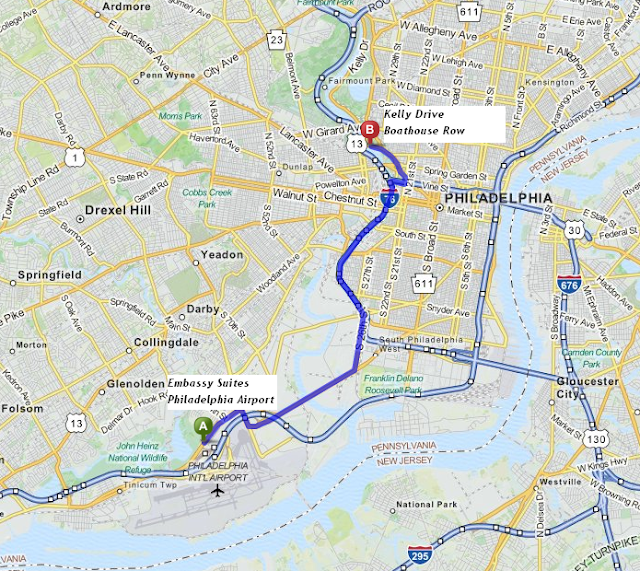
The Route

Embassy Suites Philadelphia - Airport
Embassy Suites Philadelphia Airport is joining in the Festivities by offering all Teams and Spectators of the Philadelphia International Dragon Boat Festival:
from philadelphiaboatfestival.com
History
The Past
The origin of Dragon Boat Racing dates back over 2000 years to the Chinese legend of Qu Yuan, a 4th-century statesman, poet, and adviser to the king. Qu Yuan was exiled from the ancient state of Chu after his advice to the king was misinterpreted as an attempt to assume greater political power. For his offense, Qu Yuan was banished to a remote area of Hunan Province in southern China.
The dishonor of being exiled was a heavy burden on Qu Yuan. Under the weight of his sorrow, he threw himself into the torrents of the Milou River – but some local fishermen raced out onto the water to save the drowning Qu Yuan. The fishermen wildly beat their drums and splashed the water with their paddles to prevent the water dragons and fish from eating Qu Yuan.
The modern Dragon Boat Race is based upon a traditional re-enactment of the race to save Qu Yuan. Over the centuries, village fishing boats went out each year in a symbolic search, and began to take part in races that evolved into Dragon Boat Racing’s present form.
The Present
Today, Dragon Boat Racing is one of the fastest-growing water sports in the world
The Philadelphia International Dragon Boat Festival has grown to become the largest in North America.today.
Stroll up Kelly Drive along the Schuylkill River for an unusually colorful and dramatic regatta, the Philadelphia Dragon Boat Festival, Philadelphia’s annual celebration of an ancient Chinese tradition.The boats, festooned in brilliantly colored dragon heads and tails, are manned by teams of 20 paddlers and compete against each other in several heats throughout the day.
But that’s just half the excitement. A wide range of corporate, civic and community groups send teams to this regional event, and each team sets up a tented picnic area along the riverfront — making for a fun and festive atmosphere for paddlers and spectators alike.
Proceeds from the Philadelphia races support the services of Fox Chase Cancer Center, one of the nation’s first comprehensive cancer centers.
Kelly Drive is closed to traffic for the event and parking is scarce. If you’re coming as a spectator, you will want to pack a picnic.
Live music and vendors selling dragon boat paraphernalia and other Asian goods, including clothing and crafts.
When?
October 5, 2013 8AM-5:30Pm
Where?
Kelly Drive Philadelphia, PA
The Route

Where to Stay:
Embassy Suites Philadelphia - Airport
9000 Bartram Avenue
Philadelphia, PA
Embassy Suites Philadelphia Airport is joining in the Festivities by offering all Teams and Spectators of the Philadelphia International Dragon Boat Festival:
- Free cooked to order breakfast
- Complimentary Evening Reception
- Two Room Suite
- Packages that include free parking, high speed internet and Bonus HHonor Points
- Free Hotel Shuttle to Philadelphia International Airport
Click Here to pick the overnight package right for your
Philadelphia International Dragon Boat Festival Weekend

Wednesday, September 4, 2013
Philadelphia Phillies and their Stadiums -A History of a City's Passion
Discoveries from the City Archives

Citizens Bank Park from a Wikipedia photo
By Yael Borofsky for PhillyHistory.org
The thing about October is that the weather is like the baseball — sometimes it’s hot for
most of the month, and sometimes it’s very, very cold.
After quite a few years of some very “hot” Octobers for the Philadelphia Phillies,
this year’s tenth month seems like it will be a chilly one.
But even if the Phillies miss out on a chance at the national title this year,
they may deserve another title: the Movingest Team in Baseball.
Although the Cincinatti Reds and a few other legacy baseball teams may be
close runners-up, the Phillies have switched major home parks
at least five times within the same glorious city throughout their tenure.
The superlative illustrates their unique legacy and could, by way of a jaunt through history,
distract from what will otherwise be a decidedly
disappointing October.
The Parks
Recreation Park, also known as Centennial Park (among other monikers),
was adopted as the first true home of the Philadelphia Phillies
in 1883.

A shot of the Baker Bowl Police Annual Review taking place
on the Phillies’ field.
on the Phillies’ field.
Recreation Park was outlined by
24th Street, 25th Street, Columbia and Ridge Avenue,
in what baseball author Rich Westcott described as
“the most irregularly shaped piece of land imaginable,”
in his book Philadelphia’s Old Ballparks.
To add to its physical oddity, though the park was
previously called
Columbia Park — it had been used as a baseball field by other teams since 1860 — it was also briefly
occupied by a cavalry of the Union Army in 1866. One can only assume that they didn’t squeeze a few
recreational innings in. The spot was renamed again in 1871 when the Philadelphia Centennials improved
the baseball facilities and named it Centennial Park after the team.
Albert Reach, formerly a hot shot second baseman for the Philadelphia Athletics credited with
taking that team to the 1871 pennant, brought major league
baseball and the Phillies to the bizarre spot he renamed Recreation Park.
But, according to Westcott, the fans and the Phillies outgrew the park quickly and the
team moved to a new home park, the Philadelphia Base Ball Park
(eventually known as the Baker Bowl), in 1887.
Philadelphia Park met its untimely demise in 1894 when a fire killed 12 fans and injured
more than 200 others, according to Westcott.

An aerial view of Connie Mack, which opened in 1909, but was
razed in 1976.
razed in 1976.
In the aftermath, the Phillies played in a couple
other city parks until making their next big
move to Columbia Park,
the original home of the Athletics and first
American League stadium in Philadelphia.
In addition to hosting both the
Phillies and the Athletics, the wooden park
managed to contain the City Series, in which
the two Philly teams
went head to head. Coincidentally, in 26 total City Series match-ups, each team won an even 13 times.
After Philadelphia Park was reincarnated as the Baker Bowl, the Phillies stayed put for until 1938.
Despite the fire and the new park’s infamously low, tin right field wall, it’s no surprise they stuck around –
the Phils went to their first World Series there in 1915, not to mention sustained a run of nine
consecutive first division finishes.
Westcott writes in his book of the Phillies’ success in the park: “Between 1911 and 1938,
Phillies players led or tied
for the National League in most home runs hit at home 19 times.”
In total, the Philles hit 1,314 home runs in nearly 52 years at their odd little hitter’s park at
Broad Street and Lehigh.
You can read a fuller history of the infamously weird Baker Bowl at PhillyHistory.org by
clicking here.

The dedication of Veterans Stadium. The stadium was demolished
in 2004.
in 2004.
The Phillies next set up shop at 21st and Lehigh.
Shibe Park, known as Connie Mack after 1953,
housed the team
for nearly 33 years. The park, named after
former catcher and A’s manager Cornelius McGillicuddy,
was also a
nesting ground for the Philadelphia Athletics for 46 years
and the Philadelphia Eagles for 17 years before being razed in 1976.
After Connie Mack closed in 1970, the Phillies moved on to Veterans Stadium where they finally claimed
their first World Series title in 1980.
They wouldn’t see another national victory like that until 2008, after moving to their current home, Citizen’s Bank Park, in 2004.
Over the course of more than five different home stadiums, the Phillies traveled from North to South Philly,
nabbing themselves a title as unusual as their journey and one that tells a story of adaptability,
determination, and maybe, just a little bit of faith.
References:
Wescott, Rich, Philadelphia’s Old Ballparks, Philadelphia: Temple University Press, 1996.
This entry was posted in Entertainment. Bookmark the permalink. Post a comment or leave a trackback: Trackback URL.
Friday, August 30, 2013
Philadelphia Means Business

Philadelphia Means Business
Now what you mean by "Business" is up to You!
Coming in to see your team play the Eagles at Lincoln Financial Field or the Phillies at Citizens Bank Park or perhaps the Philadelphia Union at PPL Park? Philly fans take their sports teams as very serious business as do you.
Have a meeting in the PHL Airport area, maybe in Essington or Chester, PA? We know what you mean by business. You could have just an overnight layover at PHL International. Whatever you feel is Business, it's important to you and Embassy Suites Philadelphia Airport has the perfect package for your Business: .
Philadelphia Means Business Package from Embassy Suites Philadelphia Airport includes:
- Free Parking (save $7 per day)
- Free High Speed Internet Access (save $10 per day)
Plus all the value you've come to expect from Embassy Suites Philadelphia - Airport:
- Free cooked to order breakfast Daily
- Complimentary Evening Reception
- Two Room Suite
- Hotel Shuttle to and from PHL International Airport
- Hotel Shuttle to public transportation
Whatever you mean by "Business" CLICK HERE and see how Philadelphia Means Business !
Tuesday, August 27, 2013
Hoagie 101 - The official Philly Sandwich
from visitphilly.com
Hoagies 101
Discover the history of Philadelphia’s official cold sandwich
Among Philly eats, it doesn't get much more iconic than the hoagie. The hefty sandwich of Italian origin (but now adopted by many cultures) has been an affordable lunch mainstay for the region’s residents and visitors for at least a century. And while the hoagie continues to evolve with new ingredients and modern interpretations, the classic version is as popular as ever. So what constitutes a traditional hoagie, and how did it rise to prominence? The following is a primer on all things hoagie.
What Is A Hoagie?
Declared the “official sandwich of Philadelphia” by Mayor Ed Rendell in 1992 as part of the first Wawa Hoagie Day—now celebrated during Wawa Welcome America! Fourth of July festivities—the hoagie is a built-to-order sandwich on a long Italian roll, typically filled with deli meat and cheese, garnished with fresh lettuce, tomatoes and onions, and finished with a drizzle of oregano-vinegar dressing. Now, hoagies can be filled with tuna, chicken cutlets and roasted vegetables, among other fillings. Because of its simplicity, the quality of a hoagie truly depends on the quality of its ingredients—though of course, preferences for crusty or soft, or seeded or plain bread are individual.
While similarities endure between the hoagie and the submarine (a term used in New England and elsewhere), the hoagie has some distinct qualities. Unlike a “grinder,” it is never heated or toasted.
Hoagie History
Accounts of the hoagie’s origin vary greatly, and scholars are still debating exactly where and when the sandwich was conceived. Here’s a look at some of the colorful competing stories that continue to circulate:
The Hokie
According to a 1967 article in American Speech, the word “hoagie” was first used in the late 19th or early 20th century among the Italian community in South Philadelphia. In those days, “On the hoke” was a slang term for a poor person. Deli owners would give away meat and cheese scraps on a long roll called a “hokie,” but Italian immigrants pronounced it “hoagie.”
According to a 1967 article in American Speech, the word “hoagie” was first used in the late 19th or early 20th century among the Italian community in South Philadelphia. In those days, “On the hoke” was a slang term for a poor person. Deli owners would give away meat and cheese scraps on a long roll called a “hokie,” but Italian immigrants pronounced it “hoagie.”
The Hokey
The Philadelphia Almanac and Citizen’s Manual tells of late 19th-century street vendors named “hokey-pokey men,” who sold antipasto salad, meats and cookies. When Gilbert and Sullivan’s opera Pinafore opened in Philadelphia in 1879, bakeries produced a long loaf called the pinafore, and the enterprising hokey-pokey men sliced it in half, filled it with antipasto and sold it as a “hokey,” a name that evolved into “hoagie.”
The Philadelphia Almanac and Citizen’s Manual tells of late 19th-century street vendors named “hokey-pokey men,” who sold antipasto salad, meats and cookies. When Gilbert and Sullivan’s opera Pinafore opened in Philadelphia in 1879, bakeries produced a long loaf called the pinafore, and the enterprising hokey-pokey men sliced it in half, filled it with antipasto and sold it as a “hokey,” a name that evolved into “hoagie.”
Late Night Hoagie
In 1925, a Chester couple opened the A. DiCostanza grocery store, which stayed open past midnight to accommodate gamblers from the nearby Palermo’s bar. One night, a hungry card player walked to the back of the store when Catherine DiCostanza was cooking peppers and asked if she would make him a sandwich. She asked what kind of meat he wanted and he waved to the deli counter, and said, “Put everything you have in the case in it.” She took a loaf of Vienna bread and sliced it open and stuffed it. He asked her to put some of her peppers in, too. He left, and an hour later, the place was full of hungry gamblers asking for the same kind of sandwich, which would later be known as the hoagie.
In 1925, a Chester couple opened the A. DiCostanza grocery store, which stayed open past midnight to accommodate gamblers from the nearby Palermo’s bar. One night, a hungry card player walked to the back of the store when Catherine DiCostanza was cooking peppers and asked if she would make him a sandwich. She asked what kind of meat he wanted and he waved to the deli counter, and said, “Put everything you have in the case in it.” She took a loaf of Vienna bread and sliced it open and stuffed it. He asked her to put some of her peppers in, too. He left, and an hour later, the place was full of hungry gamblers asking for the same kind of sandwich, which would later be known as the hoagie.
Hoggies
Italian immigrants working on the Hog Island shipyard during World War I (1914-1918) would bring giant sandwiches filled with cold cuts, spices and vegetables for their lunches. The workers were nicknamed “hoggies,” and over time, the name, with a different spelling, came to be attached to the sandwiches.
Italian immigrants working on the Hog Island shipyard during World War I (1914-1918) would bring giant sandwiches filled with cold cuts, spices and vegetables for their lunches. The workers were nicknamed “hoggies,” and over time, the name, with a different spelling, came to be attached to the sandwiches.
Hogans
In another version, Italian workers at Hog Island brought these same type of sandwiches to lunch, and an Irish worker looked enviously at his Italian friend and offered to buy one if his wife would make two. The Italian man went home and said, “Tomorrow, make two sandwiches, one for me and one for Hogan.” Thereafter, everyone started to call the sandwiches “Hogans,” later shortened to hoagie.
In another version, Italian workers at Hog Island brought these same type of sandwiches to lunch, and an Irish worker looked enviously at his Italian friend and offered to buy one if his wife would make two. The Italian man went home and said, “Tomorrow, make two sandwiches, one for me and one for Hogan.” Thereafter, everyone started to call the sandwiches “Hogans,” later shortened to hoagie.
King of the Hoggies
During the Depression (1929-1939), an unemployed Philadelphian named Al DePalma went to Hog Island to find work on the shipyard. When he saw workers on their lunch breaks eating giant sandwiches, his first thought was “Those fellas look like a bunch of hogs.” Instead of applying for a job, he decided to open up his own luncheonette and listed the sandwiches on his menu as “hoggies.” During the late 1930s, DePalma joined forces with Buccelli’s Bakery and developed the perfect 8-inch roll. Later, during World War II, he turned the back room of the restaurant into a factory to supply sandwiches for the shipyard workers, thus earning him the nickname as “The King of the Hoggies.” Because customers kept calling them “hoagies,” he eventually changed the name.
During the Depression (1929-1939), an unemployed Philadelphian named Al DePalma went to Hog Island to find work on the shipyard. When he saw workers on their lunch breaks eating giant sandwiches, his first thought was “Those fellas look like a bunch of hogs.” Instead of applying for a job, he decided to open up his own luncheonette and listed the sandwiches on his menu as “hoggies.” During the late 1930s, DePalma joined forces with Buccelli’s Bakery and developed the perfect 8-inch roll. Later, during World War II, he turned the back room of the restaurant into a factory to supply sandwiches for the shipyard workers, thus earning him the nickname as “The King of the Hoggies.” Because customers kept calling them “hoagies,” he eventually changed the name.
Hoagies Named For Famous Philadelphians
Few people have the distinction of having a sandwich named in their honor. And yet, some famous Philadelphians have achieved this with a signature hoagie.
The Italian hoagie (DiLusso salami, imported mortadella, hot capicola and mild provolone) at Cosmi’s Deli in South Philadelphia is named for former Philadelphia Inquirer food writer Rick Nichols.
Also at Cosmi’s is the Holiday hoagie named for sportscaster Howard Eskin, which boasts a tangy filling of prosciutto, sharp provolone, Italian tuna, olives, roasted peppers and balsamic vinegar.
The Rendelli, named for hoagie enthusiast and former Mayor and Governor Ed Rendell, was a big seller at Wawa when it was introduced during his mayoral term in the 1990s. The sandwich featured provolone, ham, pepperoni, iceberg, tomato and sweet peppers.
Tuesday, August 20, 2013
Labor Day Weekend in Philadelphia is "Made in America"
Made In America Music Festival
Labor Day weekend festival on the Benjamin Franklin Parkway returns


Benjamin Franklin Parkway, the setting for the Budweiser Made In America Festival.CREDIT: B. KRIST FOR GPTMC
Description
Dates:
August 31-September 1, 2013
August 31-September 1, 2013
Overview
Now in its second year, the Budweiser Made In America Festival is once again taking over the Benjamin Franklin Parkway on Labor Day weekend.
With nearly 30 acts performing across three stages on the Benjamin Franklin Parkway, the two-day music festival is going to be one of the year’s can’t-miss events.
This year’s lineup is incredible, with highly-anticipated performances from Beyoncé, Nine Inch Nails, Public Enemy, Emilee Sandé, Solange and more. Click here for the complete lineup.
Tickets
Tickets for the Made In America Festival are available as two-day passes or single day admission.
Two-day passes from $150
VIP Passes from $499
VIP Passes from $499
Listen Online
Get a sneak preview of this year’s Made In America Festival with a special Spotify playlist. Click here to listen online
Where to Stay?
Embassy Suites Philadelphia Airport is close enough to Benjamin Franklin Parkway to enjoy all the music and festivities and far enough away so you can relax and recharge . Only 12 minutes away Guests of Embassy Suites Philadelphia Airport enjoy:
- Free cooked to order breakfast
- Two Room Suite
- Complimentary Evening Reception
- Shuttle to public transportation
- 24 hour Philadelphia International Airport Shuttle.


Subscribe to:
Posts (Atom)